Insights
Indonesia Coal Exports: Key Trends and Market Dynamics
Dresyamaya Fiona
•
7 Minutes
read
•
Aug 26, 2026
Indonesia is a major participant in the global coal trade, with exports serving energy markets across Asia. The market is shaped by factors including production levels, export infrastructure, government policy, domestic consumption, and demand from international buyers.

Indonesia is one of the world's major coal exporters, making its export activity an important indicator for the global coal market in 2026. Changes in export volumes, export values, and destination markets can provide insights into international coal demand and market conditions.
For businesses and commodity market participants, looking at Indonesia coal export data can help provide a clearer picture of how the market is developing.
Indonesia Coal Export: A Major Source of Global Supply
Indonesia plays a significant role in the Asian coal market, supplying major importing economies across the region.
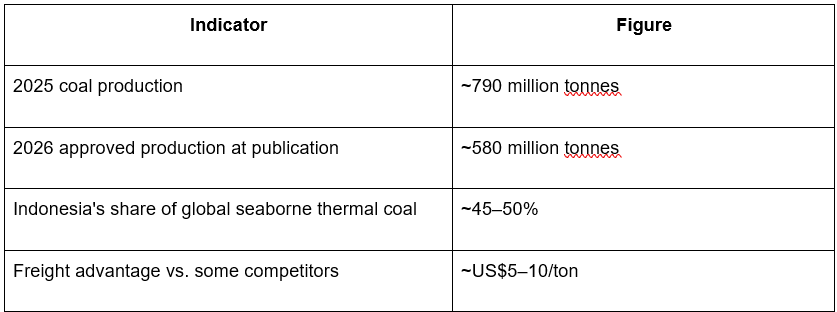
According to ASEAN Briefing, Indonesia produced approximately 790 million tonnes of coal in 2025. For 2026, approved production under the Rencana Kerja Anggaran Biaya (RKAB) process had reached around 580 million tonnes at the time of the publication, with further approvals still being processed.
This difference is important when assessing the outlook for Indonesia coal export.
Production capacity alone does not determine export availability. The amount of coal that can enter international markets depends on the volume approved for production and how that supply is allocated.
Read also: How Precious Metals React to Inflation and Interest Rates
Indonesia Coal Supply Overview
What Determines Indonesia Coal Export Availability?
Export availability is influenced by several interconnected factors.
1. Production Levels
The amount of coal produced provides the foundation for export supply.
Higher production can increase the potential volume available for international markets, while lower approved production can limit supply even when overseas demand remains strong.
In 2026, the difference between Indonesia's 2025 production and approved 2026 production highlights why production data is an important indicator for coal market participants.
2. Domestic Coal Requirements
Indonesia's coal export supply is divided between domestic consumption and exports.
The Domestic Market Obligation (DMO) requires producers to allocate part of their production to the domestic market. ASEAN Briefing notes that the current requirement is at least 25% of approved production.
This means that international buyers cannot assess Indonesian export availability simply by looking at total production.
Contract Markets vs Spot Markets
Another important consideration is the difference between contracted and spot coal supply.
Long-term contracts can provide buyers with greater visibility over future supply, while spot-market availability can change more quickly when export volumes become constrained.
When available spot supply becomes tighter, buyers without established contractual access may face greater exposure to price volatility.
For commodity traders, this makes the relationship between contracted supply, spot availability, and benchmark prices an important market indicator.
What Could Shape Indonesia Coal Export in 2026?
Several factors will be important to monitor throughout 2026.
1. Global Coal Demand
Demand from major Asian economies remainsa key driver of Indonesia's export market. Changes inelectricity consumption, industrial activity, and energy demand can influencepurchasing requirements.
2. Indonesian Production
Production approvals and actual output will determine how much coal is available across domestic and international markets.
3. International Coal Prices
Price movements will influence exportrevenue and producer margins. Higher benchmark prices can increase revenuepotential, although the final realized price depends on additional costs andmarket factors.
4. Logistics
Barging, port availability, transportation costs, and shipment delays can affect the delivered cost of Indonesian coal.
ASEAN Briefing estimates logistics costs at approximately US$5–15 per tonne, demonstrating why transportation remains an important component of coal-market economics.
Read also: Commodity Product Guide for Global Markets
Looking Ahead
Indonesia's role in the global coal market remains significant in 2026. Its large production base, proximity to major Asian buyers, and competitive freight position continue to support its importance as a seaborne coal supplier.
However, export availability depends on more than production capacity. Production approvals, domestic allocation, logistics, international demand, and coal prices all contribute to the final market outcome.
For commodity market participants, monitoring these variables can provide valuable insight into potential changes in supply, pricing, and trade flows.
Understanding Indonesia coal export data is therefore not simply about tracking how much coal leaves the country. It is about understanding how supply, demand, prices, and logistics interact to shape the broader coal market.