Insights
Commodity Sleeve Portfolio: A Framework for Investors
Dresyamaya Fiona
•
8 Minutes
read
•
Oct 7, 2026
A commodity sleeve provides a structured way to include commodities within a diversified investment portfolio. Different commodities can contribute distinct market exposures, with their potential role influenced by factors such as inflation, economic activity, supply conditions, and market cycles.

A commodity sleeve portfolio provides a structured way to gain exposure to different areas of the commodities market without concentrating on a single commodity. By combining metals, energy and soft commodities, investors can build a multi commodity sleeve around different market drivers and risk characteristics.
However, holding several commodities does not automatically eliminate risk. Each market responds differently to economic growth, inflation, supply disruptions, weather conditions, currency movements and geopolitical developments.
A disciplined approach therefore requires three key considerations, how to weight different commodity groups, when to rebalance, and which common overweight mistakes to avoid.
What is a Commodity Sleeve Portfolio?
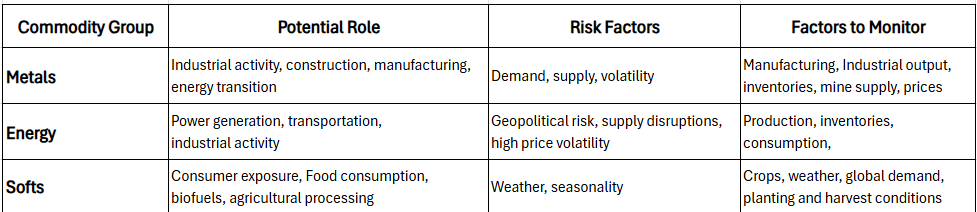
A commodity sleeve is a dedicated portion of a broader portfolio allocated to commodities. Instead of focusing on one market, a multi-commodity portfolio can include exposure across three broad groups:
- Metals: gold, silver, copper and platinum
- Energy: crude oil and natural gas
- Softs: coffee, sugar, cocoa and other agricultural commodities
Each group has different supply and demand characteristics. Metals can be influenced by industrial activity, investment demand and monetary conditions. Energy markets are sensitive to production, inventories, consumption and geopolitical developments. Soft commodities can be affected by weather, harvest conditions, seasonal cycles and agricultural supply.
This makes it important to view a commodity sleeve as a collection of different market exposures rather than one uniform asset class.
Read also: Gold Demand in Indonesia and Vietnam: What's Driving Continued Growth?
How Should a Commodity Sleeve Be Weighted?
There is no single allocation that works for every portfolio. Investors can establish a weighting framework based on their objectives, risk tolerance, investment horizon and approach to commodity markets.
Start With Strategic Weights
One approach is to establish a strategic allocation for each commodity group before considering short-term market conditions.
For example, a portfolio framework could divide commodity exposure across metals, energy and softs. The specific weighting can then be reviewed periodically based on changes in portfolio objectives and market conditions.
The purpose of strategic weighting is to create a consistent starting point rather than constantly changing allocations based on short term price movements.
Consider Risk, Not Just Capital
Equal capital allocation does not necessarily mean equal risk.
Energy, metals and soft commodities can have different levels of volatility and liquidity. A risk-aware approach can therefore consider:
- Historical and expected volatility
- Correlation between commodities
- Contract liquidity
- Position size
- Margin requirements
- Concentration by underlyingeconomic driver
Investors should also distinguish between precious and industrial metals. Gold and platinum can be influenced by investment and monetary factors, while copper is more closely linked to industrial activity and economic demand.
Rebalancing Triggers for a Multi Commodity Sleeve
Once a commodity sleeve has been established, market movements can cause its allocation to drift away from the original targets.
Portfolio rebalancing involves reviewing and potentially adjusting these allocations to bring them back toward their intended ranges.
Allocation Drift
One potential trigger is a predetermined allocation band. For example, if a commodity group has a target weight, investors can establish an acceptable range around that target. If the allocation moves materially outside the range, it can trigger a portfolio review.
This creates a more systematic approach than making decisions based solely on market sentiment.
Volatility Changes
A significant increase in volatility can also justify a review. Even if the nominal allocation remains unchanged, a sharp increase in volatility may cause one commodity group to contribute disproportionately to overall portfolio risk.
Fundamental Changes
Rebalancing can also be considered when there are meaningful changes in commodity fundamentals, including:
- Changes in global inventories
- Production or consumption forecasts
- Major weather events
- Changes in energy supply
- Structural changes in industrial demand
- Significant shifts in global trade flows
The objective is to distinguish temporary market movements from developments that could materially affect the underlying commodity.
Common Commodity Overweighting Mistakes
Chasing Recent Performance
Increasing exposure simply because a commodity has recently performed strongly can create concentration risk. Past performance does not necessarily indicate future results.
Overweighting Based on Headlines
Commodity markets can react quickly to geopolitical events, weather developments and supply disruptions. Making a large allocation change based on a single headline can result in decisions driven by short term market movements rather than broader fundamentals.
Ignoring Correlation
Holding multiple commodities does not automatically mean the portfolio is diversified. Different commodities can respond to similar economic factors, such as global growth, inflation or currency movements.
Investors should therefore consider the correlation and common drivers between positions.
Focusing Only on Capital Weight
A relatively small position can still contribute significantly to portfolio risk if the underlying commodity is highly volatile. Both capital allocation and risk contribution should therefore be considered.
Forgetting Contract Considerations
Commodity exposure can involve futures, derivatives or other instruments with different liquidity, margin and rollover characteristics. Investors should understand the relevant contract specifications and associated risks before increasing exposure.
How to Build a More Disciplined Commodity Sleeve
A structured commodity sleeve portfolio does not necessarily require predicting which commodity will perform best. Instead, investors can focus on maintaining deliberate exposure across different markets while monitoring concentration and risk.
A practical framework can include four steps:
- Define strategic weights: Establish target exposure across metals, energy and softs.
- Monitor risk contribution: Review volatility, correlations and concentration alongside capital allocation.
- Establish rebalancing triggers: Use allocation bands, volatility changes, scheduled reviews and meaningful fundamental developments
- Review overweight decisions: Consider whether an increase in exposure is based on long-term fundamentals or short-term price performance.
Read also: Precious Metal Allocation: Gold vs Silver vs Platinum
Applying the Commodity Sleeve Framework to Metal Contracts
For investors looking to explore the metals component of a commodity sleeve, ACM Exchange offers nano sized metal contracts covering several precious and industrial metals.
Available products include:
- Nano Silver (NSI): silver contract with a minimum fineness of 999
- Nano Copper (NCP): copper contract based on ASTM B115-00 Grade 1 cathode specifications
- Nano Platinum (NPT): platinum contract with a minimum purity of 99.95%
Exploring different metals can provide a way to understand the distinct characteristics of precious and industrial metals within a broader multi commodity portfolio.
Learn more about ACM Exchange's metal contracts and their respective specifications to explore how they may fit within a commodity focused strategy.
DISCLAIMER:
All information is based on sources believed to be reliable, but accuracy is not guaranteed. This content is not an offer, recommendation, or advice to buy or sell any financial products. Investing involves risks, and past performance does not guarantee future results. Advice should be sought from a financial adviser regarding the suitability of any investment product or service you may wish to purchase or subscribe to.