Insights
Why Is Platinum Price Rising in Early 2026?
Dresyamaya Fiona
•
8 minutes
read
•
Mar 3, 2026
Recent gains in platinum price reflect adjustments within commodity markets as economic and sector-specific factors evolve. Pricing patterns are shaped by industrial consumption, investor positioning, and developments affecting global metals supply.

The platinum price has been a major focus of attention in early 2026, with levels sitting well above historical averages and extending gains seen throughout 2025.
While commodity prices are often volatile, platinum’s advance reflects a combination of structural supply constraints, evolving demand patterns, investment flows, and broader macroeconomic shifts that together have supported prices near multi-year highs.
Understanding these drivers helps explain why platinum remains elevated in the current market.
Platinum Price Trends
As of early February 2026, platinum was trading above $2,100 per troy ounce, having doubled in value over the past year, despite some recent short-term volatility in the broader commodities complex.
The metal’s price trajectory in 2026 has been shaped both by its own supply-demand fundamentals and by spillover effects from other precious metals such as gold and silver, which have also seen significant movements driven by inflation expectations, currency dynamics, and investor positioning.
Difference in Platinum Price by Month 2026
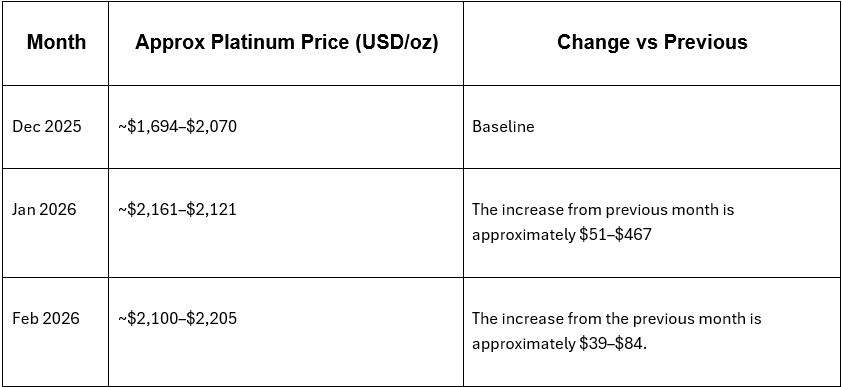
The results mean:
- January gains may have been driven by strengthening investor interest and supply-demand dynamics.
- Early February levels show some retracement after mid-January peaks, though prices remain higher than late 2025.
- Overall, platinum has traded at historically strong levels into early 2026.
Read also: Is Gold a Commodity or Currency?
What’s Driving Platinum Prices?
Platinum prices have been drawing renewed attention as the metal regains relevance across industrial, automotive, and investment markets. Unlike gold, which is driven largely by monetary and safe-haven demand, platinum sits at the intersection of precious metal and industrial commodity, making its price movements especially sensitive to real-economy trends.
Here are the key forces currently shaping platinum prices
1. Supply Constraints Are Tightening the Market
One of the most important drivers of platinum prices is structural supply tightness. Global platinum production has struggled to keep pace with demand, creating recurring market deficits.
South Africa dominates global platinum supply, accounting for the majority of mined output. Ongoing challenges such as aging mines, operational disruptions, power supply instability, and rising production costs have constrained output growth. At the same time, recycling supply — particularly from spent automotive catalytic converters, has not fully recovered to pre-pandemic levels.
When supply growth is limited in a market with relatively inelastic production, prices tend to react quickly to even modest demand increases.
2. Macroeconomic Factors Still Matter
Like other precious metals, platinum prices are influenced by broader macro conditions:
- Interest rates affect the opportunity cost of holding non-yielding assets
- US dollar strength can amplify or dampen price moves
- Global growth expectations directly affect industrial demand
Because platinum is more industrially exposed than gold, it tends to perform best when inflation risks and growth optimism overlap rather than during pure risk off environments.
Is It a Good Time to Invest in Platinum?
The platinum market has shown relatively gradual price movements over long periods, which has often led it to be viewed as a more stable precious metal compared with some alternatives. However, there have been periods where this pattern changed.
In recent years, platinum has experienced sharper price movements that contrast with its longer-term behavior. Historically, the metal has also gone through significant price swings, particularly during periods of economic stress, when changes in industrial activity and market liquidity had a strong influence on prices.
Platinum’s price is closely linked to industrial demand, as it is widely used across various manufacturing applications. As a result, changes in economic activity and production levels can affect its market performance. This characteristic highlight both its potential role in diversified portfolios and the importance of understanding its sensitivity to broader economic conditions.
When considering precious metals more broadly, different metals serve different roles. Some investors view gold as more defensive due to its long-standing use as a store of value, while platinum is more influenced by industrial factors. Each metal responds differently to market conditions, and their roles may vary depending on economic cycles and investment objectives.
Read also: Role of Copper in Electric Transportation
Conclusion
In summary, the rising platinum price in early 2026 reflects a complex various of factors: persistent supply shortages, resilient industrial and strategic demand, elevated interest from investors amid macro uncertainty, and ongoing dynamics in related precious metals markets. While short term volatility is expected, the fundamental backdrop suggests that platinum’s pricing environment will remain underpinned by structural conditions rather than purely cyclical forces.