Insights
What is a Forward Contract in Financial Markets
Dresyamaya Fiona
•
8 Minutes
read
•
Mar 5, 2026
Forward contracts are derivative instruments structured around an agreed transaction that will occur at a later date. They reference underlying assets such as commodities, currencies, or financial instruments, with contract terms determining how pricing and settlement are handled between counterparties.

In the world of financial markets and commodities trading, understanding risk management tools is essential. One commonly used instrument is the forward contract. But what is a forward contract, and why is it important for businesses and investors?
A forward contract is a customized agreement between two parties to buy or sell an asset at a predetermined price on a specific future date. Unlike exchange-traded derivatives, forward contracts are private agreements negotiated directly between the parties involved.
These contracts are widely used in commodities, currencies, interest rates, and other financial assets to hedge against price volatility.
What is a Forward Contract?
To answer the question clearly, what is a forward contract?
A forward contract is a legally binding agreement between two parties to transact an underlying asset at a fixed price on a future date. The key feature is that the terms are privately negotiated, meaning the contract can be tailored to specific needs.
The underlying assets may include:
- Commodities (oil, gold, agricultural products)
- Foreign currencies
- Interest rate instruments
- Stocks or bonds
Unlike futures contracts, forward contracts are traded over the counter (OTC), not on centralized exchanges. This structure provides flexibility but also introduces counterparty risk.
Key Characteristics of a Forward Contract
Understanding the main features helps clarify what makes forward contracts unique.
1. Customization
Forward contracts are privately negotiated agreements in which the parties determine the following terms:
- Quantity of assets
- Delivery date
- Contract price
- Settlement method
This flexibility makes forward contracts suitable for businesses with specific risk exposure.
2. Over the Counter (OTC) Trading
Forward contracts are not traded on exchanges. They are arranged directly between counterparties, often through financial institutions.
3. Obligation to Perform
Both parties are legally obligated to fulfill the contract at maturity, regardless of market price movements.
4. No Daily Settlement
Unlike futures contracts, forward contracts do not involve daily marks on the market. Profits or loss are realized only at the contract’s maturity.
5. Counterparty Risk
As for private agreements, forward contracts entail counterparty risk, meaning there is a possibility that one party may default on its contractual obligation.
Read also: Nano Contracts and How They Work
How Forward Contracts Work
Now that we understand what a forward contract is, let us examine how it works in practice.
Step 1: Agreement
Two parties agree today on:
- The asset
- The price (forward price)
- The future settlement date
Step 2: Waiting Period
Until the settlement date, the contract value fluctuates depending on market price movements. However, no money changes during this period (unless collateral arrangements are made).
Step 3: Settlement
On the agreed future date:
- If market price > forward price → the buyer benefits
- If market price < forward price → the seller benefits
Settlement can occur through:
- Physical delivery of the asset
- Cash settlement (difference between market price and forward price)
Forward Contract Example
To better understand the concept, here is a simple forward contract example:
A coffee exporter expects to sell 10 tons of coffee beans in three months. The current market price is $2,000 per ton, but prices are volatile.
To protect against price decline, the exporter enters a forward contract with a buyer to sell 10 tons at $2,050 per ton in three months.
Scenario 1: Market price falls to $1,900
The exporter still sells at $2,050, avoiding losses.
Scenario 2: Market price rises to $2,200
The exporter must sell at $2,050, missing potential additional profit.
In both cases, the forward contract eliminates uncertainty.
This forward contract example illustrates how businesses use forwards to hedge price risk rather than speculate.
Forward Contract vs. Futures Contract
Many people confuse forwards with futures. The main differences include:
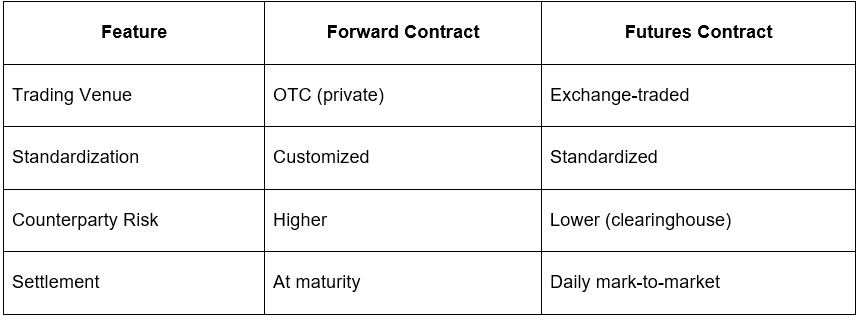
Understanding this distinction further clarifies what a forward contract is and when it may be more suitable than futures.
Who Uses Forward Contracts?
- Exporters and importers
- Commodity producers
- Financial institutions
- Multinational corporations
- Institutional investors
They are especially popular in foreign exchange markets, where companies hedge currency exposure.
Read also: The Future of Asset Management Business in Financial Services
Conclusion
So, what is the forward contract? It is a customized agreement between two parties to buy or sell an asset at a predetermined price on a future date. Forward contracts play a critical role in managing price risk, especially in commodities and foreign exchange markets.
While they offer flexibility and price certainty, they also come with counterparty risk and limited liquidity. Understanding both the advantages and risks is essential before entering into such agreements.
By reviewing a clear forward contract example, we can see how businesses use forwards primarily as a hedging tool to stabilize cash flows and protect against market volatility.
Forward contracts remain one of the foundational instruments in global finance, particularly for those seeking tailored risk management solutions.